Clicky

General

Best Back Stretchers for Desk Workers: 5 Practical Picks

Hours spent working at a desk can leave your back feeling stiff and tired. Remaining in one position for too long may reduce movement variety, while an unsuitable workstation can encourage slouching, rounded shoulders, or excessive arching through the lower back. Short walking breaks and regular position changes should form the foundation of a healthier workday. Some people also use a back stretcher as part of a brief mobility or relaxation routine after sitting. Back stretchers come in several forms. A stationary lumbar arch supports the lower back while you lie down, whereas a back wheel creates a more active rolling movement. Adjustable models allow users to begin with a lower curve before gradually trying a higher setting. The best choice depends on your mobility, experience, preferred intensity, and whether you want passive support or an active stretching tool. Here are five back stretchers desk workers can consider. Affiliate disclosure:…

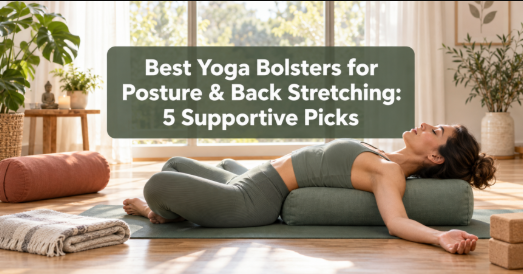
Best Yoga Bolsters for Posture & Back Stretching: 5 Supportive Picks

A yoga bolster can make restorative poses, supported backbends, seated exercises, and gentle stretches more comfortable and accessible. Unlike an ordinary bed pillow, a quality bolster is designed to maintain its shape while supporting part of your body. Placing a bolster beneath the knees may reduce the effort needed to relax the legs. Positioning one lengthwise beneath the spine can support a gentle chest-opening position. Bolsters can also elevate the hips during seated poses or provide support beneath the torso in restorative postures. The best yoga bolster for you will depend on its shape, firmness, height, filling, cover material, and intended use. Rectangular bolsters usually provide a broad, stable surface, while cylindrical models create a higher and more concentrated lift. This guide compares five yoga bolsters for posture-focused practice, back stretching, restorative yoga, meditation, and relaxation. Affiliate disclosure: This article contains affiliate links. If you purchase through one of these…

Best Pilates Rings for Posture, Core Strength & Alignment: 5 Effective Picks

Improving posture involves more than reminding yourself to sit or stand straight. Your deep core, hips, glutes, upper back, and shoulders must work together to support comfortable alignment. A Pilates ring can help you engage these muscles with greater awareness during mat-based workouts. Also called a magic circle or fitness circle, this compact tool creates resistance when you press inward or, with suitable exercises, push outward against its padded handles. That feedback can make it easier to notice whether both sides of your body are working evenly. The best Pilates rings for posture are comfortable to hold, appropriately resistant, and sturdy enough to maintain their shape. They can be placed between the hands, knees, thighs, ankles, or forearms to add a new challenge to familiar exercises. This guide compares five Pilates rings for different experience levels, body types, and budgets. Quick Comparison Pilates ring Size Best for Handle design Balanced…

Best Resistance Bands for Posture Correction Exercises: 5 Effective Picks

Long hours at a desk can leave the chest tight and upper-back muscles underused. Resistance bands strengthen the muscles supporting the shoulders, spine, and hips without requiring bulky equipment. They work well for rows, pull-aparts, face pulls, external rotations, lateral walks, and other posture-focused exercises. The best resistance bands for posture correction exercises should provide smooth, controllable tension and enough resistance options for gradual progression. They should also match the movements you plan to perform. Flat therapy bands are excellent for gentle shoulder work, tubes with handles suit rows and presses, and loop bands are useful for hip and shoulder activation. Resistance bands cannot force your body into one “perfect” posture, and posture naturally changes throughout the day. Their value comes from helping you build strength and movement capacity. Combine band exercises with mobility work, regular activity breaks, and an ergonomic workspace. Quick Comparison Product Band Style Best For Key…

Best Foam Rollers for Upper Back & Posture Exercises: 5 Effective Picks

Sitting at a computer, looking down at a phone, driving, and repeating the same workouts can leave your upper back feeling stiff, tired, and restricted. A foam roller offers an affordable way to add gentle self-massage and thoracic-mobility exercises to your daily routine. The best foam rollers for upper back and posture exercises provide enough support to help you feel stable while allowing you to control the amount of pressure. They can be used for upper-back extensions, chest-opening movements, shoulder-mobility drills, and post-workout recovery. However, a foam roller cannot permanently “fix” poor posture by itself. Posture is influenced by mobility, muscle strength, workstation setup, activity level, and daily habits. Foam rolling works best when combined with strengthening exercises, regular movement breaks, and a more ergonomic working environment. To help you choose the right option, we compared roller density, length, surface design, durability, portability, comfort, and suitability for common posture exercises.…

Best Desk Chairs Without Armrests for Better Sitting Posture: 5 Ergonomic Picks

Armrests can be helpful when properly adjusted, but they can also get in the way. Armrests that are too high may elevate your shoulders, while armrests that are too wide can force your elbows away from your body. Fixed armrests may also prevent you from moving close enough to your desk, causing you to lean forward toward your keyboard. An armless desk chair removes these obstacles. It lets you position the chair close to your work surface, move your arms freely, and store the chair beneath a compact desk when it is not being used. However, removing the armrests does not automatically make a chair ergonomic. Seat height, seat depth, lumbar support, cushioning, backrest shape, stability, and desk alignment still determine whether the chair supports comfortable sitting. In this guide, we compare five of the best desk chairs without armrests for better sitting posture. The selected models include compact mesh…

Best Seat Wedges for Anterior Pelvic Tilt & Sitting Posture: 5 Ergonomic Picks

Sitting for several hours on a flat or poorly supportive chair can make maintaining comfortable posture difficult. You may gradually slide forward, round your lower back, lean toward your computer, or place excessive pressure on your hips and tailbone. An ergonomic seat wedge can improve the angle and support of your chair. By elevating the hips slightly, a wedge may create a more open hip angle and make it easier to maintain an upright position. However, choosing the best seat wedge for anterior pelvic tilt requires care. A cushion with an excessively steep slope may push the pelvis too far forward and exaggerate the curve in the lower back. The ideal cushion should provide moderate elevation, balanced pressure distribution, and enough stability to help you sit comfortably without forcing your pelvis into one position. Below are five ergonomic seat wedges and contoured seat cushions suitable for office chairs, cars, dining…

From Back Discomfort to Better Movement: Can an Inversion Table Help?

Sitting at a desk for several hours can make maintaining a comfortable, neutral posture difficult. Even a supportive office chair cannot completely correct a workspace that positions your monitor too low, your keyboard too high, or your body in the same position throughout the day. A standing desk converter offers a practical solution without requiring you to replace your existing desk. It sits on top of your current workstation and raises your monitor, keyboard, and mouse, allowing you to alternate between sitting and standing. The best standing desk converters for better posture make this transition quick, stable, and comfortable. However, standing desk converters vary considerably in size, lifting mechanism, adjustment range, and weight capacity. Some models are ideal for laptops, while others can support dual monitors and heavier office equipment. This guide compares five of the best options to help you choose the right standing desk converter for your workspace.…

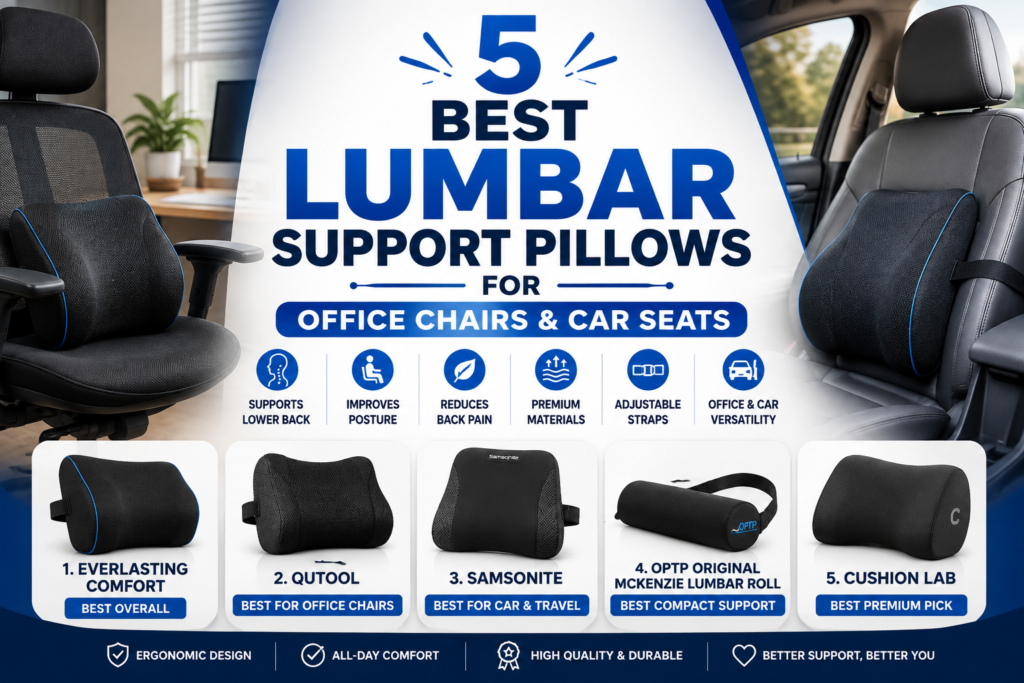
5 Best Lumbar Support Pillows for Office Chairs & Car Seats (2026)

Sitting for hours at a desk or spending long stretches behind the wheel can make even a reasonably comfortable seat feel less supportive. One common problem is the space between your lower back and the chair. Without adequate support, you may find yourself gradually slouching, shifting forward, or constantly changing position to get comfortable. A lumbar support pillow is a simple way to modify a chair without replacing it. These cushions sit between your lower back and the seat back, providing additional support around the natural lumbar curve. Some use contoured memory foam that covers much of the lower back, while others use a compact roll that provides more targeted support. The best option depends heavily on where you’ll use it. A large memory foam cushion may feel great in a deep office chair but take up too much room in a compact car seat. Conversely, a slim lumbar roll…

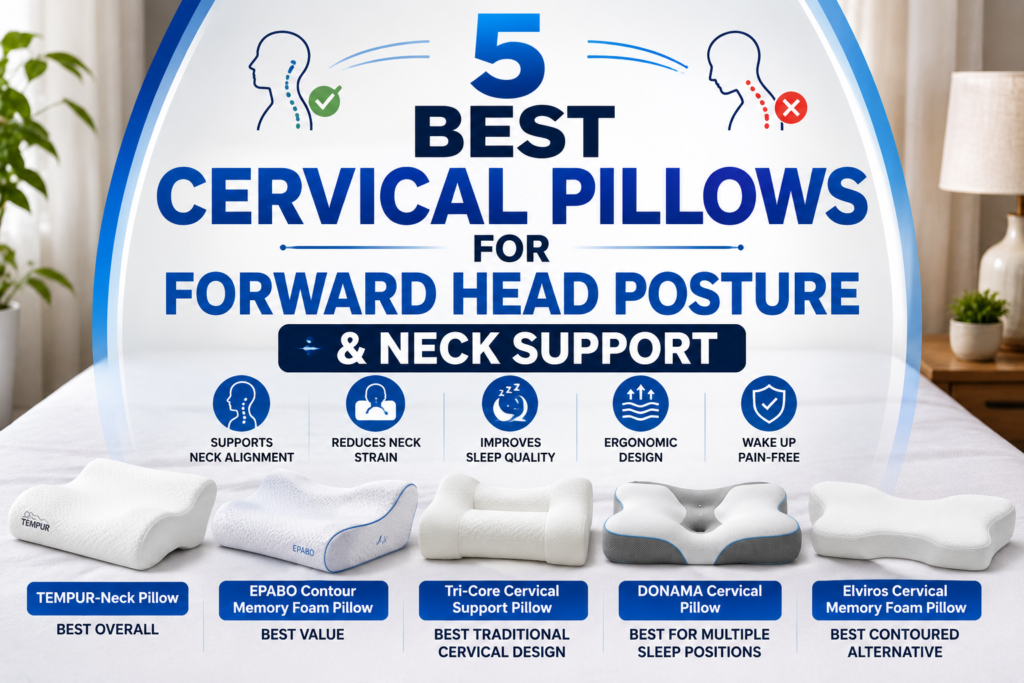
5 Best Cervical Pillows for Forward Head Posture & Neck Support (2026)

Hours spent looking down at phones, working at laptops, and sitting at poorly arranged desks can make it difficult to maintain a comfortable head and neck position throughout the day. Then bedtime arrives—and an unsuitable pillow may leave your neck in another awkward position for hours. That’s why choosing the right pillow deserves more thought than simply finding something soft. A cervical pillow is designed to support the natural shape of the neck while providing an appropriate resting position for the head. Many use a contoured shape, raised neck support, center depression, or combination of these features. For people concerned about forward head posture, the goal shouldn’t be to find a pillow promising to magically “fix” posture overnight. Instead, look for a pillow that allows your head and neck to rest comfortably without unnecessarily forcing the head forward, backward, or sideways. This distinction matters because pillow height and shape aren’t…

Navigate