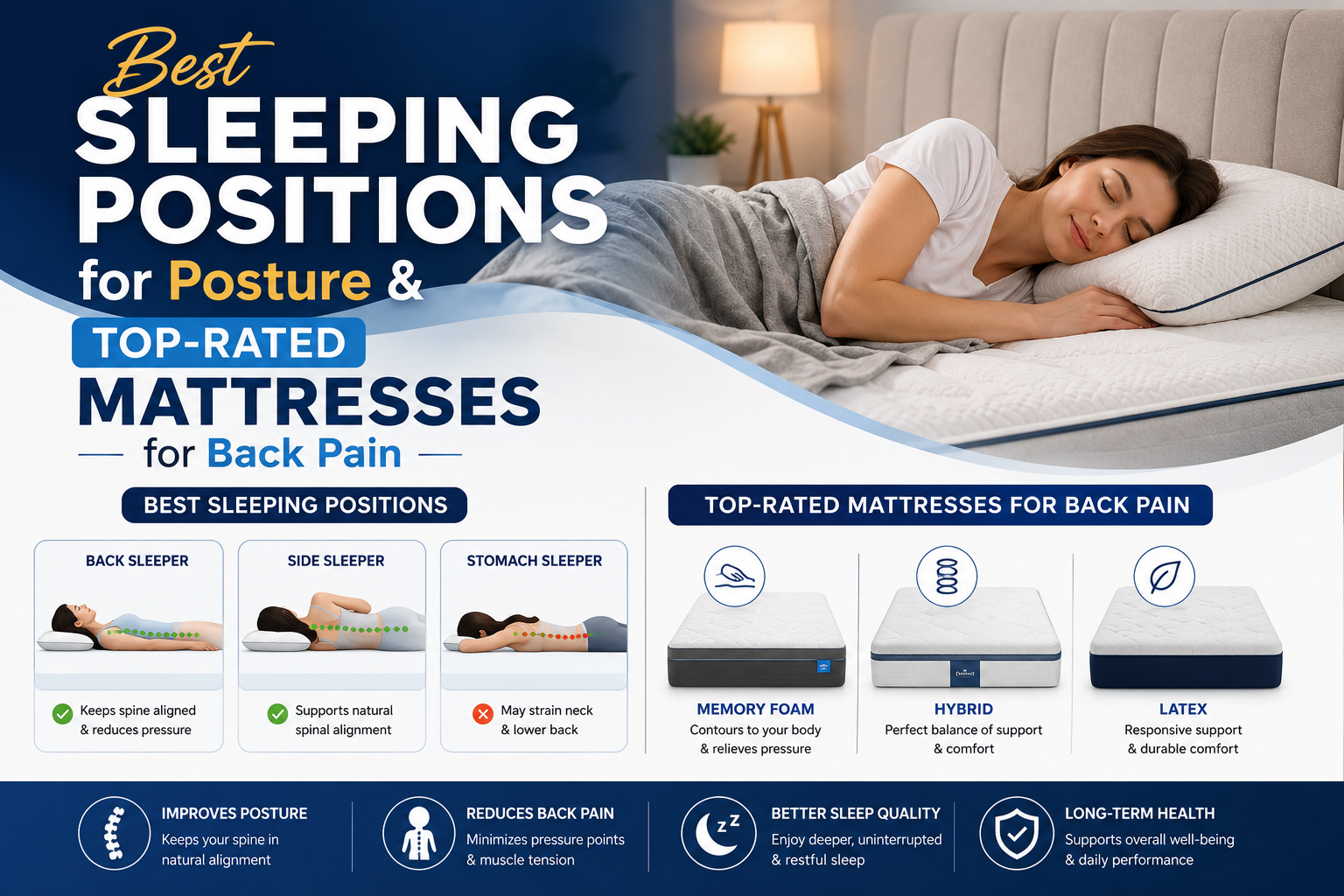
If you wake up with a stiff neck, sore shoulders, or persistent lower back pain, your sleeping position and mattress could be the hidden culprits.
Most people spend roughly one-third of their lives sleeping, yet few realize how much their sleep posture impacts spinal alignment, muscle recovery, and long-term health. Even if you maintain good posture during the day, sleeping in the wrong position on an unsupportive mattress can undo much of your progress.
The good news is that small adjustments to your sleeping habits—and choosing the right mattress—can significantly reduce pain, improve posture, and help you wake up feeling refreshed.
In this guide, we’ll explore the best sleeping positions for posture, explain which positions to avoid, and review the top-rated mattresses for back pain that can help support healthy spinal alignment.
Why Sleep Posture Matters
Table of Contents
 Your spine has three natural curves:
- Cervical curve (neck)
- Thoracic curve (upper back)
- Lumbar curve (lower back)
The goal during sleep is to maintain these natural curves as much as possible.
When your sleeping position forces the spine out of alignment, it can lead to:
- Lower back pain
- Neck stiffness
- Shoulder discomfort
- Muscle tension
- Poor sleep quality
- Increased pressure on joints
Over time, poor sleep posture may contribute to chronic pain and mobility issues.
Signs Your Sleeping Position Is Hurting Your Posture
 You may need to change your sleeping habits if you regularly experience:
✔ Morning back pain
✔ Neck stiffness
✔ Tingling in arms or legs
✔ Shoulder pain
✔ Frequent headaches
✔ Restless sleep
✔ Feeling sore upon waking
If these symptoms sound familiar, your sleeping position may be working against your body’s natural alignment.
The Best Sleeping Positions for Posture
 Not all sleeping positions are created equal. Some support spinal health, while others increase stress on joints and muscles.
Let’s examine the best options.
1. Sleeping on Your Back (Best Overall)
Why It’s Best
 Most posture experts agree that sleeping on your back provides the most neutral spinal alignment.
When done correctly, this position distributes body weight evenly and minimizes pressure points.
Benefits
- Maintains natural spinal curves
- Reduces neck strain
- Minimizes pressure on hips
- Supports lower back alignment
- Helps prevent facial wrinkles
How to Optimize It
Place a small pillow beneath your knees.
This reduces pressure on the lumbar spine and helps maintain its natural curve.
Best For
- Lower back pain
- Neck pain
- General posture improvement
Potential Drawbacks
Back sleeping may worsen snoring or sleep apnea symptoms for some individuals.
2. Side Sleeping (Best for Most People)
Why It’s Popular
 Side sleeping is the most common sleeping position worldwide.
When properly supported, it’s an excellent option for posture and spinal health.
Benefits
- Reduces pressure on the spine
- Improves circulation
- Helps reduce acid reflux
- Supports healthy breathing
How to Optimize It
Place a pillow between your knees.
This prevents the upper leg from rotating forward and twisting the pelvis.
Keep your head aligned with your spine using a supportive pillow.
Best For
- Pregnant individuals
- Mild back pain sufferers
- Snorers
- Side sleepers seeking spinal alignment
3. Fetal Position (With Modifications)

Many people naturally curl into a fetal position.
While generally safe, excessive curling can create spinal rounding.
Benefits
- Comfortable for many sleepers
- Reduces snoring
- Can ease lower back pressure
Tips
Avoid curling too tightly.
Aim for a relaxed side-sleeping posture rather than a tightly folded position.
Sleeping Positions to Avoid
4. Sleeping on Your Stomach (Worst for Posture)
 Stomach sleeping is generally considered the least posture-friendly position.
Why It’s Problematic
To breathe while lying face down, your neck must remain rotated for hours.
This creates:
- Neck strain
- Shoulder stress
- Lower back compression
Common Problems
- Morning neck pain
- Numbness
- Increased spinal stress
If you’re a stomach sleeper, consider gradually transitioning to side sleeping.
How Pillows Affect Posture During Sleep
 Even the best sleeping position can be undermined by the wrong pillow.
Back Sleepers
Choose:
- Medium loft pillow
- Cervical support design
Side Sleepers
Choose:
- Higher loft pillow
- Firm support
Stomach Sleepers
Choose:
- Thin pillow
- Soft materials
A properly sized pillow helps keep the head aligned with the spine.
How Your Mattress Affects Back Pain
 Your mattress plays an equally important role in spinal health.
A mattress that’s too soft allows excessive sinking.
A mattress that’s too firm can create pressure points.
The ideal mattress:
- Supports natural spinal alignment
- Relieves pressure
- Prevents excessive sinking
- Maintains comfort throughout the night
What to Look for in a Mattress for Back Pain
 Medium-Firm Support
Research consistently shows medium-firm mattresses work well for most people with back pain.
Pressure Relief
Memory foam and hybrid designs often excel here.
Motion Isolation
Especially important for couples.
Edge Support
Improves durability and usable sleep surface.
Cooling Features
Helpful for hot sleepers.

Top-Rated Mattresses for Back Pain
Below are some highly-rated mattress options commonly recommended for spinal support and back pain relief.
1. Nectar Memory Foam Mattress
Best Overall Value
 The Nectar Mattress combines pressure relief with excellent spinal support.
Features
- Medium-firm feel
- Gel memory foam
- Excellent motion isolation
- Long trial period
Pros
✔ Great pressure relief
✔ Affordable
✔ Strong support
Cons
✘ May feel warm for some sleepers
Best For
Back sleepers and side sleepers.
link on price Amazon
2. Saatva Classic Mattress
 Best Luxury Hybrid Mattress
The Saatva Classic remains one of the most recommended mattresses for back pain.
Features
- Coil-on-coil support system
- Lumbar support enhancement
- Multiple firmness options
Pros
✔ Excellent spinal alignment
✔ Premium materials
✔ Durable construction
Cons
✘ Higher price point
Best For
Chronic back pain sufferers.
link on price Amazon
3. DreamCloud Hybrid Mattress
Best Hybrid Mattress
 DreamCloud combines memory foam comfort with supportive pocketed coils.
Features
- Hybrid design
- Pressure-relieving foam
- Strong edge support
Pros
✔ Excellent support
✔ Luxury feel
✔ Good cooling
Cons
✘ Heavier mattress
Best For
Combination sleepers.
link on price Amazon
4. Tuft & Needle Original Mattress
Best Budget Option
 A quality mattress doesn’t have to cost a fortune.
Features
- Adaptive foam
- Medium-firm support
- Cooling technology
Pros
✔ Affordable
✔ Good support
✔ Minimal motion transfer
Cons
✘ Less contouring than memory foam
Best For
Budget-conscious buyers.
link on priceAmazon
5. Tempur-Pedic TEMPUR-Adapt
Best Premium Memory Foam Mattress
 Tempur-Pedic remains one of the most trusted names in sleep technology.
Features
- Advanced pressure relief
- Exceptional body contouring
- Superior durability
Pros
✔ Outstanding support
✔ Excellent pain relief
✔ Long lifespan
Cons
✘ Premium pricing
Best For
Serious back pain sufferers.
link on price Amazon
Mattress Comparison Table
| Mattress | Type | Firmness | Best For |
|---|---|---|---|
| Nectar | Memory Foam | Medium-Firm | Value |
| Saatva Classic | Hybrid | Multiple Options | Back Pain |
| DreamCloud | Hybrid | Medium-Firm | Combination Sleepers |
| Tuft & Needle | Foam | Medium-Firm | Budget Buyers |
| Tempur-Pedic Adapt | Memory Foam | Medium | Premium Support |
Additional Tips for Better Sleep Posture
Stretch Before Bed
Gentle stretching helps reduce muscle tension and improves spinal mobility.
Replace Old Mattresses
Most mattresses should be replaced every 7–10 years.
Maintain Healthy Weight
Excess body weight can increase spinal stress during sleep.
Stay Active
Regular exercise strengthens muscles that support good posture.
Use Proper Pillow Support
Small adjustments often provide significant benefits.
Frequently Asked Questions
What is the healthiest sleeping position?
Sleeping on your back is generally considered the healthiest position for spinal alignment and posture.
Is side sleeping bad for posture?
No. Side sleeping can be excellent for posture when using a supportive pillow and placing a pillow between the knees.
Can a mattress really help back pain?
Yes. A supportive mattress can significantly reduce spinal stress and improve sleep quality.
How often should I replace my mattress?
Most experts recommend replacing mattresses every 7 to 10 years depending on wear and support quality.
Is memory foam good for back pain?
Memory foam can be highly effective because it contours to the body while reducing pressure points.
Final Thoughts
Improving your posture doesn’t stop when you go to sleep. In fact, your sleeping position and mattress may be among the most important factors influencing spinal health.
For most people, back sleeping remains the best sleeping position for posture, while side sleeping is an excellent alternative when properly supported. Avoid stomach sleeping whenever possible, as it places excessive strain on the neck and lower back.
Pairing healthy sleep posture with a high-quality mattress such as the Nectar, Saatva Classic, DreamCloud, Tuft & Needle, or Tempur-Pedic Adapt can make a significant difference in reducing back pain and improving overall sleep quality.
Investing in better sleep isn’t just about comfort—it’s an investment in your long-term health, posture, and well-being.
Affiliate Disclosure
This article contains affiliate links. If you purchase through these links, we may earn a commission at no additional cost to you. This helps support our content and allows us to continue providing unbiased reviews and helpful buying guides.