Your feet are the foundation of almost every standing and walking movement you make. When that foundation changes, the effects don’t necessarily stop at your ankles.
Flat feet—also known as pes planus—occur when the arches of the feet are low or flatten significantly while standing. Flat feet are common, and many people with them experience no pain at all. However, in some individuals, flatter arches are accompanied by excessive inward rolling of the foot, known as overpronation. That movement can influence how forces travel through the ankles, knees, hips, pelvis, and potentially the lower back.
This doesn’t mean that flat feet automatically cause poor posture or back pain. Back pain is complex and can have many causes. Research into foot orthoses and flat feet also remains mixed. A recent 2025 meta-analysis found benefits from insoles for several measures associated with flexible flat feet, while previous reviews have emphasized considerable variation in study quality and outcomes.
Understanding the connection can nevertheless help you make smarter decisions about footwear, insoles, activity, and professional treatment.
What Are Flat Feet?
Table of Contents
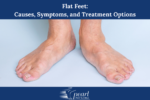 The arch along the inside of the foot helps distribute forces while you stand, walk, and run.
With flat feet, this medial arch is lower than usual or collapses toward the floor when weight is placed on the foot. Research describes adult flatfoot as involving lowering of the medial longitudinal arch together with changes such as hindfoot eversion and forefoot abduction.
There are different types of flat feet.
Flexible flat feet have an arch when the foot isn’t bearing weight, but the arch becomes flatter while standing.
Rigid flat feet remain relatively flat even when the foot isn’t bearing weight and may require more careful clinical evaluation.
Some people have had flat feet since childhood. Others develop changes to their arches over time because of age, injury, tendon problems, body weight, arthritis, footwear habits, or other factors.
How Your Feet Can Influence Your Posture
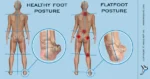 Your feet don’t function independently from the rest of the body.
Imagine your body as a kinetic chain:
Feet → Ankles → Knees → Hips → Pelvis → Spine
When your feet contact the ground, every step generates forces that move upward through this chain.
A certain amount of pronation is normal. It helps the foot absorb shock.
Problems may occur when the foot rolls inward excessively or doesn’t control that motion effectively.
For some people, excessive pronation can encourage the lower leg to rotate inward. That may influence knee positioning and hip mechanics, which can alter how the pelvis and lower back manage movement.
The relationship varies considerably between individuals, however, so seeing flat feet does not automatically establish the cause of someone’s back symptoms.
How Flat Feet May Affect Your Back
1. Changes in Lower-Limb Alignment
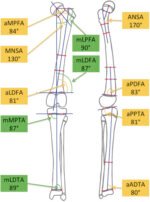 When the foot excessively pronates, the ankle and lower leg may rotate differently during walking.
Those changes can continue upward toward the knee and hip.
If your body repeatedly compensates for altered foot mechanics, muscles around your hips and trunk may have to work differently to stabilize you.
Over thousands of steps each day, relatively small changes can become noticeable.
2. Altered Pelvic Mechanics
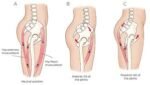 Your hips connect your legs to your pelvis.
Changes in hip rotation can therefore affect pelvic positioning during walking and standing.
The pelvis, in turn, connects directly with your lumbar spine.
This doesn’t necessarily mean your pelvis becomes permanently “misaligned.” Human posture is naturally variable. Rather, the body may use different movement strategies to compensate for what is happening lower in the kinetic chain.
3. Muscle Fatigue
People with symptomatic flat feet sometimes experience fatigue in the feet or lower legs after  prolonged walking or standing.
When supporting muscles become tired, other regions may contribute more to maintaining stability.
Some people then notice discomfort extending into the knees, hips, or lower back.
Research reviews of adult flat feet have reported associations with lower-extremity musculoskeletal complaints, though the evidence for specific treatment strategies remains inconsistent.
4. Uneven Shoe Wear
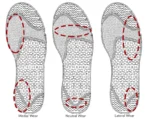 Your shoes can provide useful clues.
Look at the soles of an older pair.
Heavy wear concentrated along certain areas may indicate how your feet load the ground, although shoe wear alone isn’t enough to diagnose a gait problem.
A podiatrist or physical therapist can assess your walking pattern more accurately.
Signs Your Flat Feet May Be Causing Problems
Many people have flat feet without symptoms and don’t need treatment.
Consider getting your feet evaluated if you repeatedly experience several of these problems:
- Foot or arch discomfort
- Ankle fatigue
- Heel discomfort
- Shoes wearing unevenly
- Knees appearing to collapse inward during movement
- Persistent knee or hip discomfort
- Difficulty standing for long periods
- Lower-back discomfort associated with prolonged walking or standing
- A noticeable change in one foot’s arch
- Significant differences between the two feet
New or rapidly changing foot shape deserves particular attention.
Can Insoles Help Flat Feet and Back Comfort?
Orthotic inserts are among the most common conservative options for symptomatic flat feet.
They generally work by providing support beneath specific parts of the foot and altering how pressure is distributed inside the shoe.
The evidence deserves some nuance.
A 2025 network meta-analysis of eight randomized controlled trials found that insoles—particularly when combined with exercise—improved several clinical and biomechanical outcomes in flexible flatfoot.
However, earlier systematic reviews found substantial variation among studies and concluded that evidence supporting orthoses in adults with flat feet was limited or inconsistent.
Evidence for treating back pain specifically with insoles is similarly mixed. A newer meta-analysis found improvements in pain and disability but rated the overall evidence quality as low and cautioned about differences between studies. Earlier reviews reached less favorable conclusions.
The practical takeaway is straightforward:
Insoles may help some people—especially those with symptomatic flat feet or pronation—but they shouldn’t be marketed as a guaranteed treatment for back pain.
Recommended Insoles and Foot-Support Options
Below are useful starting points for shoppers looking for supportive inserts. The right choice depends on your arch shape, footwear, activity, comfort, and professional recommendations.
1. PowerStep Pinnacle Maxx — Best for Overpronation Support
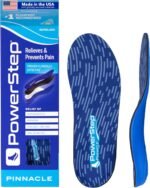 Why Consider Them
They offer a combination of arch support, cushioning, and stability and are commonly marketed toward overpronation.
Best for: Walking shoes, everyday footwear, and users wanting firmer support.
2. Dr. Scholl’s Stability Support Insoles — Best Budget-Friendly Option
Dr. Scholl’s Stability Support Insoles provide a more accessible option for users who want additional arch and heel support without immediately investing in higher-priced orthotics.
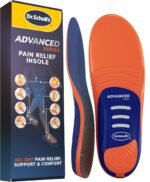 Why Consider Them
They’re widely available and straightforward to fit into many everyday shoes.
Best for: First-time insole users and budget-conscious shoppers.
3. WALK·HERO Arch Support Insoles — Best Affordable Firm Arch Support
WALK·HERO-style orthotic inserts are another common choice for shoppers who prefer noticeable arch support.
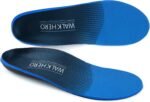 Look for the correct size and make sure the insert doesn’t create excessive pressure beneath your arch.
4. Spenco Total Support Max — Best for Structured Foot Control
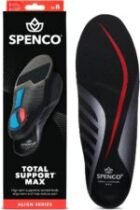 Spenco’s Total Support line combines cushioning with a relatively structured design.
This can be attractive for people who spend significant time walking or standing and want an insert that feels more supportive than basic cushioning.
5. Superfeet Support Insoles — Best Premium Everyday Option
Superfeet offers multiple insole shapes and arch profiles rather than a single universal design.
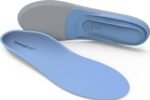 That’s important because the “highest arch” isn’t automatically the best insole. Your goal should be comfortable support that matches your foot and shoe.
How to Choose Insoles for Flat Feet
Match the Insole to Your Foot
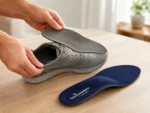 People often assume flat feet require the highest possible arch.
Not necessarily.
An arch that feels aggressively high can create new pressure and discomfort.
A supportive insole should feel noticeable without painfully digging into the foot.
Check Heel Stability
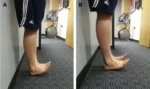 A structured heel cup can help position the rear of the foot inside the shoe.
This feature may be particularly useful when overpronation accompanies flat feet.
Don’t Ignore Shoe Volume
 Adding a thick insert to a tight shoe can create toe crowding.
If possible, remove the shoe’s original removable insole before installing the orthotic.
Consider Your Activity
The ideal insert for standing at work isn’t necessarily the same as one for running.
Choose according to whether you’ll primarily use it for:
- Daily walking
- Running
- Work boots
- Hiking
- Gym training
- Casual shoes
Break Them In Gradually
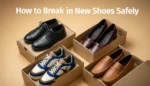 A structured orthotic may feel different from your usual shoe.
Instead of immediately wearing a new pair for a 10-hour workday, gradually increase wear time over several days if the manufacturer or clinician recommends doing so.
Stop if the insert creates persistent or worsening pain.
Insoles Aren’t the Whole Solution
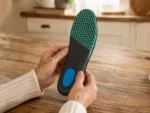 Foot support can be helpful, but treating every movement issue with an insert alone ignores the role of muscle strength and mobility.
A comprehensive approach may include exercises targeting your feet, calves, hips, and core.
Short-Foot Exercise
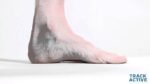 While standing or sitting, gently draw the ball of your foot toward your heel without curling your toes.
This teaches you to activate muscles that help support the arch.
Calf Raises
Stand near a wall or sturdy surface.
Slowly rise onto your toes and return.
Calf raises strengthen muscles involved in ankle and foot control.
Toe Control Exercises
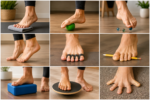 Practice lifting your big toe while keeping the other toes down, then reverse the movement.
This may improve foot awareness and intrinsic muscle coordination.
Hip Strengthening
Because the foot is part of a larger kinetic chain, exercises such as bridges, controlled squats, and side-lying hip movements can complement foot-focused work.
The latest evidence also suggests that combining exercises with insoles may provide greater benefit for flexible flatfoot than relying on the insert alone.
Choose Supportive Shoes Too
Even an excellent insole has limited value inside poorly fitting footwear.
Look for shoes that provide:
A secure heel: Your heel shouldn’t repeatedly slide around.
Adequate width: Your toes need room rather than being squeezed together.
Stable construction: A shoe that twists extremely easily may offer less control than some users with symptomatic overpronation prefer.
Removable insoles: This makes replacing the manufacturer’s insert easier.
Comfort: A supportive shoe that hurts isn’t a good shoe for you.
What About Barefoot Walking?
Barefoot movement isn’t automatically good or bad for flat feet.
Some people tolerate it comfortably, while others experience foot fatigue or symptoms without supportive footwear.
Training barefoot for short periods may help develop foot strength in suitable individuals, but suddenly switching from supportive shoes to spending an entire day barefoot can substantially increase load on structures that aren’t accustomed to it.
Increase activity gradually.
When Should You See a Podiatrist?
Consider professional evaluation if:
- Your feet are persistently painful.
- One arch has recently collapsed.
- You have substantial swelling.
- Walking has become difficult.
- Symptoms persist despite changing shoes.
- You experience persistent knee, hip, or back pain.
- You have diabetes or another condition affecting foot health.
- You’re considering expensive custom orthotics.
A professional assessment can determine whether your symptoms actually relate to foot mechanics or whether another problem deserves attention.
Frequently Asked Questions
Can flat feet cause lower-back pain?
Flat feet can influence lower-limb mechanics, and in certain individuals those changes may contribute to discomfort farther up the kinetic chain. However, flat feet aren’t automatically the cause of lower-back pain.
Will arch-support insoles fix my posture?
No insert can permanently “fix” posture on its own. Orthotics can alter foot loading and may improve comfort or mechanics for some users, but strength, mobility, activity, footwear, workstation habits, and many other factors influence posture.
Are custom orthotics better than store-bought insoles?
Not universally. Some people do well with prefabricated inserts, while others require custom devices because of their anatomy or symptoms. Current research does not support treating every person with flat feet the same way.
Should everyone with flat feet wear insoles?
No. Asymptomatic flat feet often don’t require treatment. The strongest reason to consider intervention is usually symptoms or functional difficulty—not appearance alone.
How long do insoles last?
It depends on the material, body weight, frequency of use, footwear, and activity. Replace them when cushioning is compressed, structural support noticeably changes, or the manufacturer recommends replacement.
Final Verdict
Understanding how flat feet affect your back begins with recognizing that your body works as an interconnected movement system.
Your feet influence your ankles, knees, hips, and pelvis, and changes in foot mechanics may therefore influence the way your spine manages movement. But the relationship isn’t simple enough to say that every person with flat feet will develop poor posture or back pain.
For symptomatic flat feet or overpronation, supportive insoles can be a reasonable conservative option. Recent research provides encouraging evidence for orthoses—especially when paired with exercise—although the scientific literature remains mixed and results vary between individuals.
For shoppers seeking stronger support, PowerStep Pinnacle Maxx is a useful place to start. Dr. Scholl’s Stability Support offers a more affordable alternative, while WALK·HERO, Spenco, and Superfeet provide additional choices across different support levels.
Just remember that the goal isn’t to force every foot into an artificial “perfect” arch. The goal is comfortable movement, appropriate support, good footwear, progressive strength, and less pain.
If foot, knee, hip, or back symptoms continue despite those changes, consult a podiatrist, physical therapist, or other qualified healthcare professional for an individualized assessment.