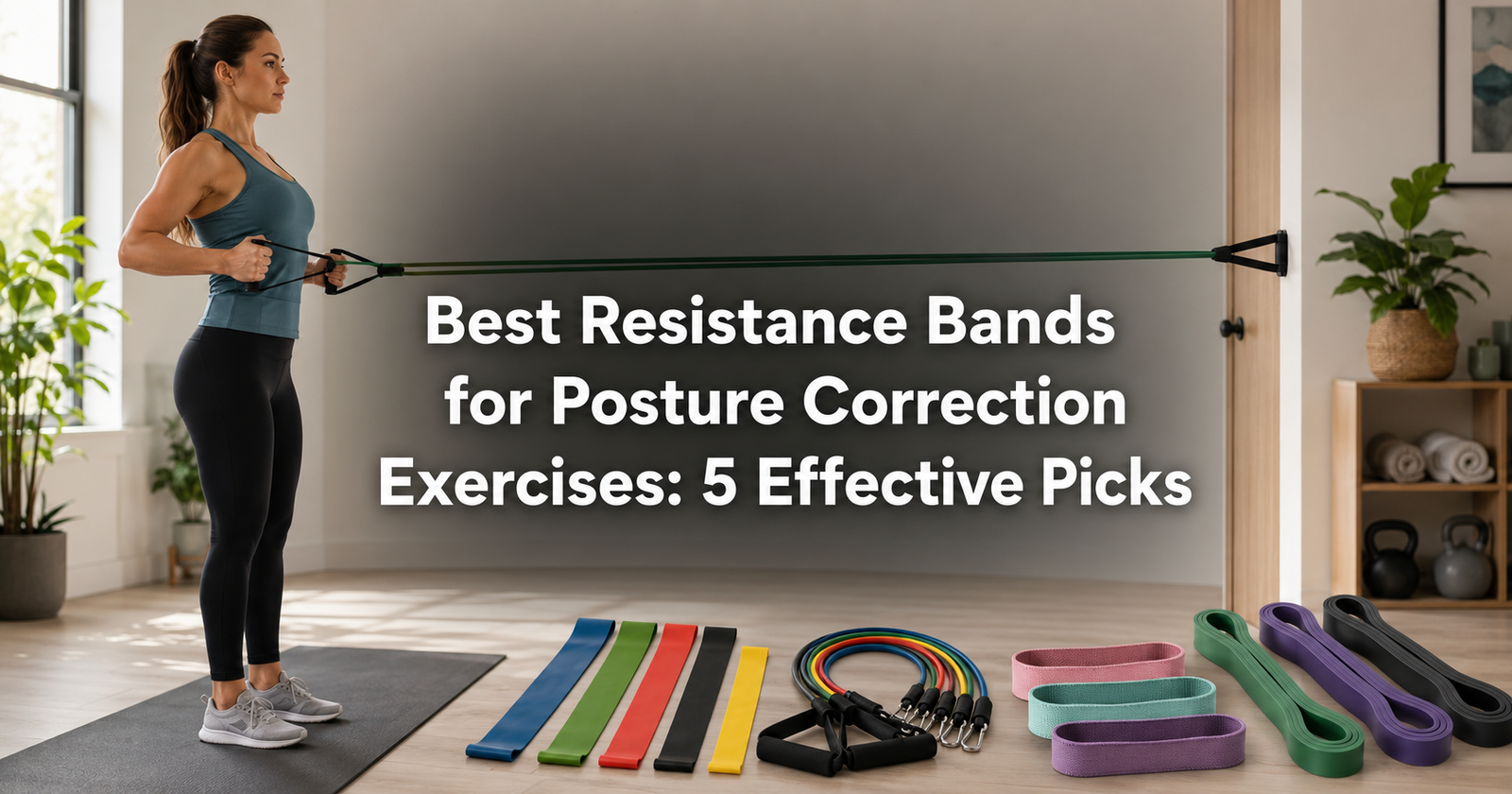
Long hours at a desk can leave the chest tight and upper-back muscles underused. Resistance bands strengthen the muscles supporting the shoulders, spine, and hips without requiring bulky equipment. They work well for rows, pull-aparts, face pulls, external rotations, lateral walks, and other posture-focused exercises.
The best resistance bands for posture correction exercises should provide smooth, controllable tension and enough resistance options for gradual progression. They should also match the movements you plan to perform. Flat therapy bands are excellent for gentle shoulder work, tubes with handles suit rows and presses, and loop bands are useful for hip and shoulder activation.
Resistance bands cannot force your body into one “perfect” posture, and posture naturally changes throughout the day. Their value comes from helping you build strength and movement capacity. Combine band exercises with mobility work, regular activity breaks, and an ergonomic workspace.
Quick Comparison
Table of Contents
| Product | Band Style | Best For | Key Advantage |
|---|---|---|---|
| THERABAND Non-Latex Resistance Bands | Flat therapy bands | Best overall | Gentle, progressive resistance |
| Bodylastics Stackable Band Set | Tubes with handles | Complete home workouts | Stackable tension and safety cords |
| Fit Simplify Loop Bands | Mini loops | Beginners and hip stability | Five compact resistance levels |
| Serious Steel 41-Inch Bands | Long loops | Pull-aparts and mobility | Wide resistance range |
| WHATAFIT Resistance Band Set | Tube kit | Budget shoppers | Handles, straps and door anchor |
Resistance ratings and included accessories vary by set. Check the selected Amazon listing before ordering.
1. THERABAND Non-Latex Resistance Bands — Best Overall
THERABAND flat bands are a strong overall choice for controlled posture exercises. They do not have handles or fixed loops, so you can adjust the working length and tension simply by changing your grip.
 This flexibility makes them suitable for pull-aparts, external rotations, diagonal raises, shoulder mobility, and gentle rehabilitation-style movements.
The non-latex line is particularly useful for people with latex sensitivities. Different colors represent progressive resistance levels, allowing beginners to start with light tension and advance gradually as their technique and strength improve.
Flat bands also make it easy to keep resistance modest during exercises involving smaller shoulder muscles.
Because each band is thin and flexible, it fits easily inside a desk drawer, backpack, or travel bag. The tradeoff is that a flat band may roll, bunch, or feel uncomfortable in the hands during harder pulling exercises. It also lacks the convenience of padded handles and a door anchor.
Best for: Beginners, gentle upper-body strengthening, mobility work, and people who need a non-latex resistance band.
2. Bodylastics Stackable Resistance Band Set — Best Complete System
The Bodylastics system is a versatile option for anyone building a complete posture-strengthening workout at home.
Its resistance tubes connect to handles, ankle straps, or a door anchor. This setup makes exercises such as standing rows, face pulls, reverse flyes, pulldowns, presses, external rotations, and Pallof presses easier to perform.
The tubes can be used individually or stacked together to create additional resistance. Progression is straightforward: master an exercise with one light tube, then add tension without replacing your complete system.
 Bodylastics offers several configurations, so the number of tubes and maximum combined resistance depend on the kit you select.
One notable feature is the internal safety cord, which is intended to reduce overstretching and limit recoil if the outer tube fails. However, no resistance band is completely risk-free.
Inspect the tubes, clips, handles, stitching, and attachment points before every workout. Use the door anchor only with a secure door that closes away from your body.
The Bodylastics system costs more than a basic package of mini-loop bands and includes more components to organize. In exchange, it provides the widest exercise variety among our five recommendations.
Best for: People who want a complete resistance-band home gym for posture exercises and full-body strength training.
3. Fit Simplify Resistance Loop Exercise Bands — Best for Beginners
The Fit Simplify mini-loop set contains five 12-by-2-inch natural-latex bands. The resistance levels range from extra light to extra heavy, allowing beginners to progress gradually.
These bands are small, affordable, and simple to use. They are especially helpful for lower-body exercises that support upright movement and stability, including lateral walks, clamshells, glute bridges, standing hip abductions, and squat variations.
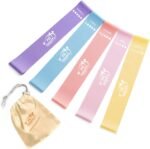 You can also use the lighter loops for shoulder activation by carefully positioning one around your hands or wrists. Exercises such as wall slides and banded reaches can help activate the shoulders and upper back.
However, these short loops are not the best choice for traditional standing rows, pulldowns, or face pulls because their range is limited.
The bands are made from natural latex, which may not be suitable for people with latex allergies or sensitivities. According to the manufacturer, the set includes a carry bag, exercise guide, eBook, and access to online workout videos.
For portable hip and shoulder activation, this five-level set delivers useful progression at an accessible price.
Best for: Beginners, travel workouts, glute strengthening, shoulder activation, and short exercise breaks near the desk.
4. Serious Steel 41-Inch Resistance Bands — Best Long Loop Bands
Serious Steel’s continuous 41-inch resistance bands provide enough length for pull-aparts, rows, pulldowns, assisted stretching, shoulder-mobility drills, and full-body strength training.
The manufacturer offers several widths, with resistance ranges extending from very light tension to extremely heavy strength-training resistance.
For posture-focused shoulder exercises, lighter options are usually the most practical. Serious Steel identifies its orange No. 0 band, rated at approximately 2–15 pounds, for warm-ups, stretching, rehabilitation, and shoulder activation.
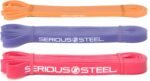 The purple No. 1 band offers approximately 5–35 pounds of resistance, while the red No. 2 band supplies approximately 10–50 pounds. Heavier bands are more appropriate for lower-body strength training or assisted pull-ups than smaller shoulder exercises.
The bands are made from layered natural latex. Their continuous-loop construction eliminates handles and clips, but changing resistance requires switching bands or adjusting your grip, stance, or anchor position.
Serious Steel bands are normally sold individually unless a listing clearly states that it is a set. Review the package contents carefully before purchasing.
Best for: Users wanting a durable long loop for pull-aparts, rows, assisted mobility, stretching, and strength exercises.
5. WHATAFIT Resistance Band Set — Best Budget Tube Kit
The WHATAFIT tube set is a popular budget-friendly option for shoppers who want multiple accessories without paying the price of a premium resistance system.
Typical packages include several resistance tubes, two handles, ankle straps, a door anchor, and a storage bag. The tubes can generally be used individually or combined to change the total resistance.
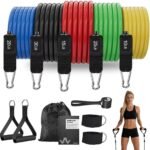 This format works particularly well for standing rows, reverse flyes, face pulls, pulldowns, external rotations, and anti-rotation core exercises.
The padded handles may feel more comfortable than gripping flat rubber during longer workouts. A door anchor also creates useful pulling angles without requiring permanent wall-mounted equipment.
Package contents and printed resistance ratings can vary between versions, so check the exact listing before ordering.
Budget tubes may show wear sooner than premium products. Inspect the rubber, clips, stitching, handles, straps, and anchor regularly. Replace any part that becomes cracked, frayed, discolored, sticky, or deformed.
Best for: Budget-conscious users who want a versatile resistance-band starter kit with handles and accessories.
How Resistance Bands Can Support Better Posture
Posture is not simply a matter of pulling your shoulders backward throughout the day. Comfortable alignment depends on mobility, strength, muscular endurance, coordination, breathing, and regularly changing positions.
Resistance-band exercises can strengthen the upper back, rear shoulders, rotator cuff, glutes, and trunk. These muscles help you tolerate sitting, standing, reaching, lifting, and working for longer periods.
Bands also provide increasing resistance as they stretch. This makes them useful for developing control throughout a movement without requiring heavy weights.
The objective should be smooth movement and appropriate muscular effort—not forcing your body into a stiff or unnatural position.
Five Resistance-Band Exercises for Posture
1. Band Pull-Aparts
Hold a light resistance band at shoulder height with your elbows straight but not locked.
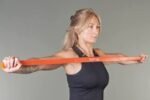 Move your arms outward and gently pull the band apart. Stop when your arms are comfortably extended to the sides, then return slowly to the starting position.
Avoid shrugging, pushing your head forward, or aggressively squeezing your shoulder blades together.
2. Standing Band Rows
Secure the band to a stable anchor at approximately chest height. Hold the handles or ends and step backward until there is light starting tension.
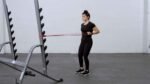 Pull your hands toward your ribs while keeping your chest comfortable and neck relaxed. Pause briefly before slowly extending your arms.
Avoid arching your lower back or using momentum.
3. Band Face Pulls
Attach a tube band slightly above eye level. Hold the handles with your arms extended and palms facing inward.
 Pull the handles toward your face while allowing your elbows to move outward. Use light-to-moderate resistance and maintain an upright position.
Do not lean backward to complete the repetition.
4. Shoulder External Rotations
Secure a light band beside your body. Keep your elbow close to your side and bent to approximately 90 degrees.
Rotate your forearm outward against the resistance while keeping your upper arm relatively still. A folded towel between your elbow and torso can help you maintain the correct position.
This exercise should use light tension and controlled movement.
5. Lateral Band Walks
Place a mini-loop band above your knees or around your ankles. Keep your knees slightly bent and maintain a small hip hinge.
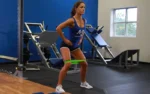 Take controlled steps sideways without allowing your knees to collapse inward. This movement activates the hip muscles that help support lower-body alignment and stability.
Start with one or two sets of 8–15 comfortable repetitions for each exercise. The final repetitions should feel challenging, but your technique should remain controlled and pain-free.
How to Choose Resistance Bands for Posture Exercises
Select the Right Band Style
Flat therapy bands provide precise, gentle resistance and work especially well for shoulder exercises.
Tube systems with handles are suitable for rows, face pulls, presses, and anchored movements. Mini loops are convenient for hip and shoulder activation, while long loop bands provide the greatest versatility for mobility and strength training.
Start With Lighter Resistance
Posture-focused exercises often target smaller muscles that do not require extreme tension.
A lighter band makes it easier to control the movement and reduces the temptation to shrug your shoulders, arch your lower back, hold your breath, or rely on momentum.
Increase the resistance only after you can complete every repetition with consistent technique.
Look for Useful Accessories
A secure door anchor expands your exercise options and helps you perform rows, pulldowns, face pulls, and anti-rotation exercises.
Padded handles make repeated pulling more comfortable, while ankle straps support hip-strengthening movements. A storage bag protects the bands from sunlight, heat, and sharp objects.
Consider the Material
Natural latex is highly elastic and widely used in resistance bands, but it may not be suitable for people with latex allergies.
Non-latex synthetic bands are available. Check the manufacturer’s material information rather than judging the band only by its appearance or color.
Check the Available Resistance Levels
A set with several tension levels allows you to use lighter resistance for shoulder exercises and heavier resistance for rows, squats, and lower-body training.
Do not assume that color systems are universal. A red band from one company may provide different resistance from a red band made by another manufacturer.
Resistance-Band Safety Tips
Inspect every resistance band before exercising. Stop using it if you notice cracks, tears, thinning, sticky patches, discoloration, fraying, damaged stitching, or bent hardware.
Keep bands away from rough flooring, sharp edges, extreme temperatures, and prolonged direct sunlight.
Test every anchor with gentle tension before beginning your workout. Never secure a band to an unstable chair, lightweight furniture, sharp railing, loose post, or door that could open toward you.
Avoid stretching a resistance band beyond the manufacturer’s recommended limit. Keep your face away from the direct recoil path, particularly during face pulls and overhead exercises.
Stop exercising if you experience sharp pain, numbness, tingling, dizziness, or worsening symptoms.
Consult a physical therapist, doctor, or qualified fitness professional if you have a recent injury, surgery, neurological symptoms, or persistent neck, shoulder, or back pain.
Frequently Asked Questions
Can resistance bands fix poor posture?
Resistance bands cannot fix posture by themselves, but they can strengthen muscles and improve movement control.
Combine band exercises with mobility work, walking, workstation adjustments, regular breaks, and frequent changes of position.
How often should I perform posture exercises?
Two or three strengthening sessions per week is a reasonable starting point for many people.
Short sessions using light resistance may be performed more frequently if they do not cause pain, unusual soreness, or excessive fatigue.
Which resistance level should a beginner use?
Start with a light band that allows you to complete approximately 10–15 smooth repetitions without holding your breath or changing your technique.
Move to a stronger band when every repetition feels controlled and the current resistance no longer provides an adequate challenge.
Are loop bands or tube bands better?
Mini loops are useful for hip and shoulder activation, while tubes with handles are better suited to rows, pulldowns, face pulls, and presses.
Neither style is universally better. The right option depends on your preferred exercises.
How long do resistance bands last?
Their lifespan depends on the material, construction, frequency of use, storage conditions, and amount of stretching.
Inspect your bands regularly and replace them as soon as you notice significant wear or damage.
Final Verdict
The THERABAND Non-Latex Resistance Bands are our best overall recommendation because they provide gentle, adjustable resistance for upper-back, shoulder, and mobility exercises.
Choose the Bodylastics Stackable Resistance Band Set if you want a more complete home system with handles and anchor accessories.
The Fit Simplify Loop Bands offer an affordable option for hip and shoulder activation, while the Serious Steel 41-Inch Bands are ideal for users who want durable long loops for mobility and strength exercises.
The WHATAFIT Resistance Band Set provides a selection of handles and accessories at a budget-friendly price.
Select the band style that matches your exercises, begin with manageable tension, inspect your equipment regularly, and progress gradually.