Hours spent looking down at phones, working at laptops, and sitting at poorly arranged desks can make it difficult to maintain a comfortable head and neck position throughout the day. Then bedtime arrives—and an unsuitable pillow may leave your neck in another awkward position for hours.
That’s why choosing the right pillow deserves more thought than simply finding something soft.
A cervical pillow is designed to support the natural shape of the neck while providing an appropriate resting position for the head. Many use a contoured shape, raised neck support, center depression, or combination of these features.
For people concerned about forward head posture, the goal shouldn’t be to find a pillow promising to magically “fix” posture overnight. Instead, look for a pillow that allows your head and neck to rest comfortably without unnecessarily forcing the head forward, backward, or sideways.
This distinction matters because pillow height and shape aren’t one-size-fits-all. Your sleeping position, shoulder width, body size, mattress firmness, and personal comfort all influence what works.
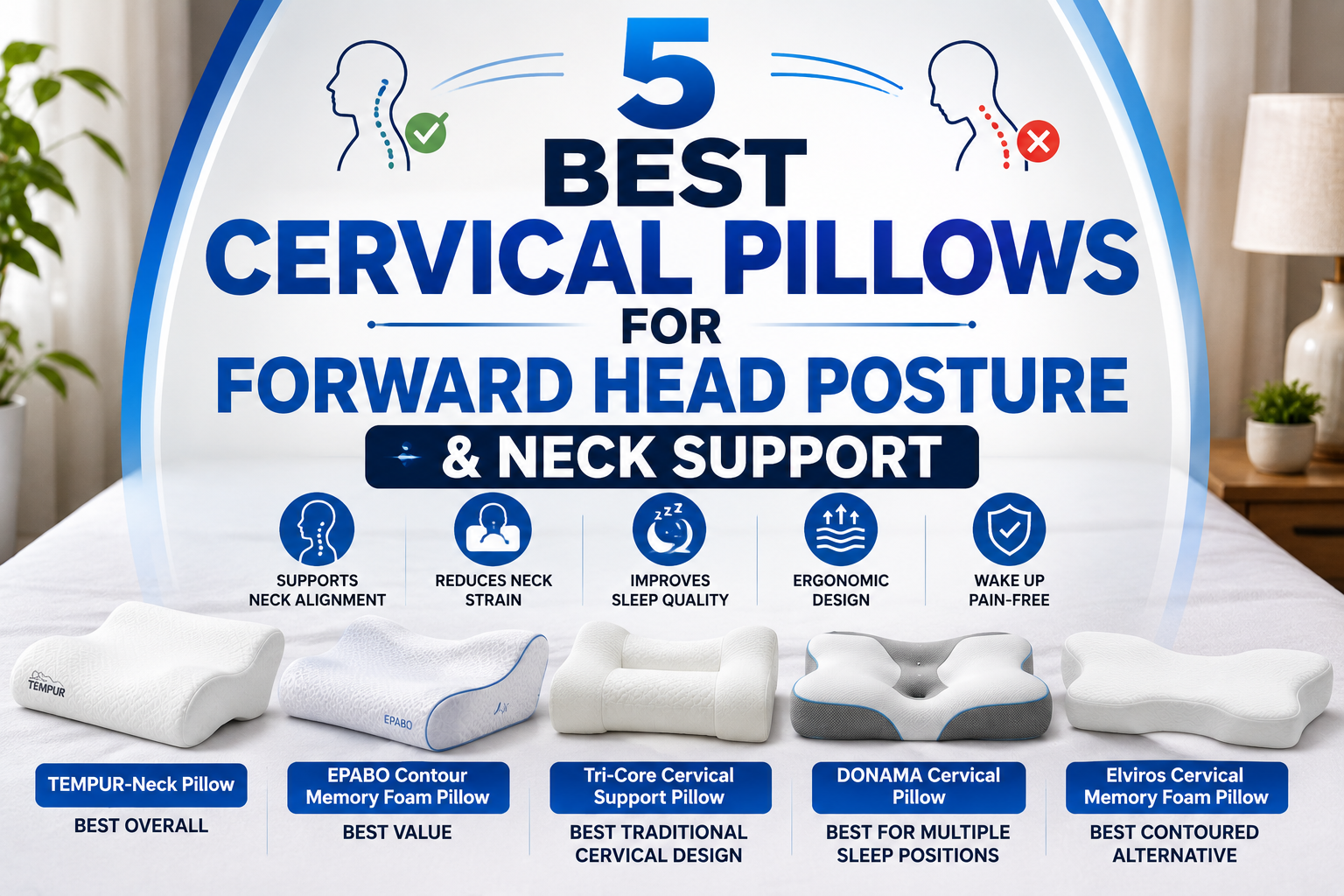
We’ve selected five cervical pillows worth considering, from traditional orthopedic designs to modern contoured memory foam options.
Quick Comparison: Our Top 5 Cervical Pillows
Table of Contents
| Product | Best For | Design |
|---|---|---|
| TEMPUR-Neck Pillow | Best Overall | Contoured TEMPUR material |
| EPABO Contour Memory Foam Pillow | Best Value | Contoured memory foam |
| Core Products Tri-Core Cervical Support Pillow | Best Traditional Cervical Design | Fiber cervical roll |
| DONAMA Cervical Pillow | Best for Multiple Sleep Positions | Butterfly contour memory foam |
| Elviros Cervical Memory Foam Pillow | Best Contoured Alternative | Ergonomic memory foam |
Pillow comfort is highly individual. Product dimensions and designs may change, so verify the current size and specifications before ordering.
1. TEMPUR-Neck Pillow — Best Overall
The TEMPUR-Neck Pillow is our best overall choice for sleepers who want a premium cervical pillow from an established bedding brand.
Rather than using a conventional rectangular block of foam, the pillow has a contoured profile intended to follow the natural curve between the head, neck, and shoulders.
The proprietary TEMPUR material is known for responding to body pressure and maintaining a substantial, supportive feel.
One particularly useful aspect of this pillow is the availability of different profiles. That’s important because cervical support isn’t simply about buying the tallest possible pillow.
A pillow that’s too high can place the neck in an awkward position just as easily as one that’s too low.
 Why We Like It
- Purpose-built contoured neck design
- Premium pressure-responsive material
- Multiple profile options
- Established manufacturer
- Substantial supportive feel
- Particularly suitable for back and side sleepers
What Could Be Better
The TEMPUR-Neck is significantly more expensive than many Amazon cervical pillows.
Its firmer, shaped feel may also require an adjustment period if you’re accustomed to sleeping on soft down or loose-fill pillows.
Choosing the correct profile is especially important.
Who Should Buy It?
Back and side sleepers who want a premium, structured pillow and are willing to pay more for an established brand.
Verdict
The TEMPUR-Neck Pillow is our best overall choice for sleepers prioritizing structured cervical support, premium materials, and multiple sizing options.
2. EPABO Contour Memory Foam Pillow — Best Value
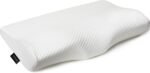
The EPABO Contour Memory Foam Pillow offers the familiar cervical contour shape at a more accessible price.
Its ergonomic design creates raised areas for neck support with a lower area for the head.
That shape can be useful for sleepers who find conventional pillows either collapse too much underneath the neck or push the entire head upward.
The memory foam also gives the pillow a more consistent structure than traditional loose-fill alternatives.
 Why We Like It
- Affordable compared with premium cervical pillows
- Contoured memory foam construction
- Designed around neck support
- Removable pillowcase
- Good entry point into ergonomic pillows
- Suitable for several sleeping preferences
What Could Be Better
Memory foam can feel warmer than highly breathable latex or fiber pillows.
The fixed contour also means there’s less room for customization than you’d get with an adjustable-fill pillow.
As with any cervical pillow, the shape may not suit every body type.
Who Should Buy It?
Anyone who wants to experiment with a contoured cervical pillow without immediately investing in a premium model.
Verdict
The EPABO is our value pick because it provides a straightforward contoured memory foam design at a relatively accessible price.
3. Core Products Tri-Core Cervical Support Pillow — Best Traditional Cervical Design
Not every cervical pillow needs to look like a sculpted block of memory foam.
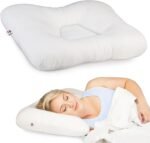
The Core Products Tri-Core Cervical Support Pillow takes a more traditional orthopedic approach.
Its distinctive design combines a recessed center with cervical rolls intended to support the neck while the head rests closer to the center of the pillow.
This makes it substantially different from an ordinary bed pillow.
The Tri-Core has been around for years and remains popular with people specifically looking for structured cervical support rather than simply a comfortable memory foam pillow.
 Why We Like It
- Established cervical-support design
- Recessed center section
- Different neck-roll sizes
- Traditional fiber feel
- Multiple sizes/firmness configurations available
- Good alternative to solid memory foam
What Could Be Better
This is probably the pillow in our roundup most likely to require an adjustment period.
The shape is intentionally different from a standard pillow, and some sleepers may find it unusually firm or restrictive initially.
Side sleepers should also pay particular attention to sizing because they typically require enough height to fill the space between the shoulder and head.
Who Should Buy It?
Sleepers specifically seeking a traditional cervical-support pillow and those who don’t like the dense feel of solid memory foam.
Verdict
The Tri-Core is our favorite traditional cervical pillow for buyers who prefer a fiber-filled orthopedic design over molded memory foam.
4. DONAMA Cervical Pillow — Best for Multiple Sleep Positions
The DONAMA Cervical Pillow represents the newer generation of butterfly-shaped ergonomic pillows commonly found on Amazon.
Instead of a simple wave contour, its sculpted design includes a central head area, raised neck-support zones, and side sections intended to accommodate different sleeping positions.
This makes it particularly interesting for combination sleepers who don’t remain in exactly one position all night.
The arm areas can also feel more natural for sleepers who like positioning their hands near or underneath the pillow.
 Why We Like It
- Butterfly-style ergonomic shape
- Contoured memory foam
- Designed for back and side sleeping
- Arm-placement areas
- Multiple height zones
- Good option for combination sleepers
- Removable cover
What Could Be Better
The unusual shape isn’t for everyone.
If you frequently move around your entire bed or prefer a large conventional pillow surface, the sculpted design may feel restrictive.
And although products of this type are frequently marketed for “neck pain relief,” individual results vary considerably.
Who Should Buy It?
Combination sleepers interested in a modern contoured design with multiple resting zones.
Verdict
The DONAMA is our pick for sleepers who frequently alternate between back and side positions and want more positioning options than a simple wave pillow provides.
5. Elviros Cervical Memory Foam Pillow — Best Contoured Alternative
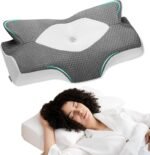
The Elviros Cervical Memory Foam Pillow is another sculpted option designed around the shape of the head, neck, and shoulders.
Its contour provides different height zones, allowing users to choose the side that better suits their body and sleeping preference.
That’s useful because pillow loft is one of the most important variables in maintaining a comfortable neck position.
Side sleepers generally need enough height to fill the gap created by the shoulder, whereas back sleepers often need less.
The Elviros gives shoppers another option when a conventional rectangular pillow doesn’t provide enough structure.
 Why We Like It
- Ergonomic contoured shape
- Memory foam construction
- Multiple height zones
- Accommodates different sleeping positions
- Structured neck area
- Good alternative to butterfly designs
What Could Be Better
Like other molded foam pillows, it can’t be adjusted infinitely.
If neither contour height matches your body, removing a handful of fill isn’t an option like it would be with an adjustable shredded-foam pillow.
Some sleepers may also need several nights to adapt to the shape.
Who Should Buy It?
Back and side sleepers who prefer a structured memory foam contour and want more than one height option.
Verdict
The Elviros is a strong alternative for shoppers who want a modern cervical contour with multiple height zones.
What Is Forward Head Posture?
Forward head posture generally describes a position where the head sits farther forward relative to the trunk than a neutral alignment.
It’s commonly discussed in relation to prolonged computer work, smartphone use, and other activities that encourage people to look downward or project their head toward a screen.
Importantly, posture isn’t a simple disease-versus-healthy binary.
Research has found an association between increased forward head posture and neck-pain measures in adults, but posture alone doesn’t explain every case of neck discomfort.
That’s why a pillow should be viewed as one part of a broader approach rather than a cure.
Can a Cervical Pillow Correct Forward Head Posture?
This is where marketing language often goes too far.
There isn’t good reason to promise that sleeping on a particular Amazon pillow will permanently “correct” forward head posture.
A more realistic objective is comfortable nighttime positioning and cervical support.
During sleep, an appropriate pillow should help keep your head and neck in a comfortable relationship with your upper body rather than excessively flexing or extending the neck.
Your daytime habits still matter enormously.
If you spend eight hours leaning toward a laptop, buying a cervical pillow doesn’t eliminate the need to improve your workstation, movement habits, or seek professional guidance when appropriate.
How to Choose a Cervical Pillow
1. Start With Your Sleeping Position
Your normal sleeping position should be one of your first considerations.
Back Sleepers
 Back sleepers generally need enough neck support without pushing the head excessively forward.
A contoured pillow with a lower central area can work well for some people.
Side Sleepers
Side sleepers usually need greater loft because the pillow must fill the space between the mattress  and head created by the shoulder.
Shoulder width and mattress firmness influence the ideal height.
Stomach Sleepers
Stomach sleeping already requires significant neck rotation.
A thick cervical pillow may increase awkward positioning for some stomach sleepers, so lower-profile options are generally worth considering.
2. Pay Attention to Pillow Loft
Loft means pillow height.
This may be even more important than the brand.
 A pillow that’s too high can push a back sleeper’s head forward.
A pillow that’s too low can allow a side sleeper’s head to tilt toward the mattress.
There is no universal “correct” cervical pillow height because bodies and mattresses differ.
That’s why products offering several sizes, multiple contour heights, or adjustable fill can be particularly useful.
3. Consider Your Mattress
 Pillow recommendations shouldn’t ignore the mattress underneath you.
On a softer mattress, your shoulder may sink farther into the surface, reducing the pillow height required.
On a firm mattress, your shoulder remains higher, potentially increasing the amount of space the pillow must fill.
Evaluate the pillow and mattress as a system.
4. Memory Foam vs. Fiber
Memory Foam
 Memory foam provides consistent structure and contouring.
Advantages:
- Holds its shape
- Pressure-responsive
- Works well for sculpted designs
- Minimal fluffing
Disadvantages:
- Can sleep warmer
- Fixed molded designs aren’t very adjustable
- Some people dislike the dense feel
Fiber
Fiber pillows such as the Tri-Core feel more familiar.
Advantages:
- Traditional pillow feel
- Often more breathable
- Can feel less restrictive
Disadvantages:
- Fill may compress over time
- Requires occasional reshaping
- Support can be less uniform
Neither material is automatically better.
5. Don’t Assume Firmer Means Healthier
A cervical pillow needs enough structure to support your preferred position, but extremely firm isn’t automatically superior.
Comfort matters because a pillow you can’t comfortably sleep on isn’t useful.
Recent expert pillow guidance similarly emphasizes choosing according to sleeping position and appropriate loft rather than assuming one pillow design works for everyone.
What Else Can Help With Forward Head Posture?
Your sleep setup is only one part of the picture.
If forward head posture is your concern, consider what happens during the other 16 hours of the day.
Raise Your Computer Screen
If you’re constantly looking downward at a laptop, consider a laptop stand or external monitor positioned more appropriately.
Bring Screens Toward You
Don’t lean your head toward a monitor simply because text is difficult to see.
Adjust text scaling or move the screen to a comfortable distance.
Change Positions
Even an apparently “perfect” posture can become uncomfortable when held continuously.
Regularly change positions and take movement breaks.
Consider Exercise
Research reviews of treatments for chronic neck pain associated with forward head posture have studied exercise and manual-therapy programs rather than relying solely on passive products.
If symptoms persist, professional assessment can help determine what’s appropriate for you.
How Long Does It Take to Get Used to a Cervical Pillow?
Some people adapt immediately.
Others need several nights or longer.
Contoured cervical pillows can feel unusual because they don’t behave like conventional soft pillows.
Rather than forcing yourself through significant discomfort, follow the manufacturer’s adaptation instructions where provided.
If the pillow consistently causes new pain, numbness, headaches, or other concerning symptoms, stop using it and seek appropriate professional advice.
Frequently Asked Questions
What is the best cervical pillow for forward head posture?
There’s no single pillow that’s best for everyone.
Our best overall pick is the TEMPUR-Neck Pillow because it offers a structured contour and multiple profile options from an established manufacturer.
However, your sleeping position and body dimensions matter more than simply buying our #1 choice.
Can sleeping without a pillow fix forward head posture?
There’s no universal evidence-based rule that people with forward head posture should sleep without a pillow.
For many side sleepers in particular, removing the pillow would leave a substantial gap between the head and mattress.
Should a cervical pillow be high or low?
It should be appropriate for your sleeping position, body dimensions, and mattress.
Back sleepers often require less loft than side sleepers.
Are cervical pillows good for side sleepers?
They can be, provided the pillow offers enough height to accommodate the shoulder and maintain a comfortable head position.
Are cervical pillows good for back sleepers?
Many cervical designs are particularly well suited to back sleepers because they combine neck support with a lower area for the head.
Again, excessive height should be avoided.
Is memory foam best for cervical support?
Memory foam is popular because it maintains a structured shape, but it isn’t universally superior.
Some people prefer latex, fiber, or adjustable shredded foam.
Can a pillow cure neck pain?
No pillow should be presented as a guaranteed cure for neck pain.
Neck discomfort can have many causes. Persistent, severe, traumatic, or neurologically associated symptoms deserve appropriate medical evaluation.
Final Verdict: Which Cervical Pillow Should You Buy?
The TEMPUR-Neck Pillow is our best overall choice for shoppers who want premium materials, a dedicated cervical contour, and several profile options.
For shoppers who want to spend less, the EPABO Contour Memory Foam Pillow provides a more affordable introduction to contoured cervical support.
The Core Products Tri-Core Cervical Support Pillow is our preferred traditional orthopedic option for people who don’t want molded memory foam.
Combination sleepers should consider the DONAMA Cervical Pillow, whose butterfly-style design provides several resting zones.
Finally, the Elviros Cervical Memory Foam Pillow offers another strong contoured option with multiple height zones.
But don’t choose purely according to rankings.
The best cervical pillow for forward head posture is ultimately one that matches your sleeping position, shoulder width, body size, mattress, and preferred firmness while allowing your neck to rest comfortably.
And remember what a pillow can—and can’t—do.
It can support your neck while you’re sleeping.
It can’t undo an entire day of poor workstation ergonomics, eliminate the need for movement, or guarantee correction of forward head posture.
Treat it as one component of a better overall posture and sleep setup, and you’re much more likely to make a useful purchase rather than falling for an unrealistic marketing promise.